
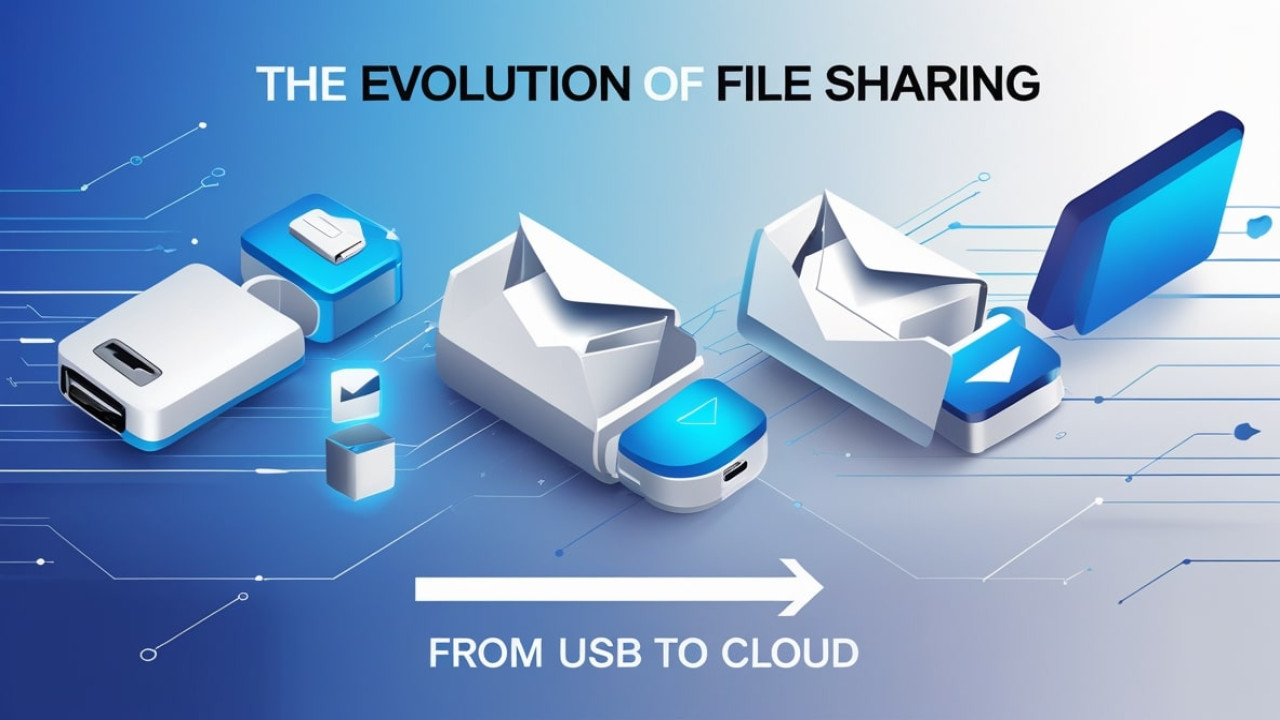
The Evolution of File Sharing: From USB Drives to the Cloud
It’s just about noon on a Monday here in Colombo, and the usual start-of-the-week hustle is in full swing. I was just digging through an old desk drawer looking for a cable and my hand brushed against it: a dusty, 128-megabyte USB drive. A little relic from a bygone era. A little wave of nostalgia washed over me. I remember thinking this tiny little stick was the absolute pinnacle of technology.
You could carry hundreds of files in your pocket! It’s funny, isn’t it? How quickly the revolutionary becomes the mundane. We now share massive, high-definition video files with colleagues on the other side of the planet with a single click, and we don’t even blink. But that seamless, instant reality we take for granted is the result of a quiet, and incredibly rapid, evolution. Let’s take a little trip back in time, from the satisfying clunk of a floppy disk to the invisible magic of the cloud.
The Age of the Physical Hand-Off
For those of us of a certain vintage, the sound is unforgettable: the whirring, clicking, and clunking of a 3.5-inch floppy disk drive. This was the original file sharing. You’d save your precious document which had to be smaller than 1.44 megabytes, a size that’s laughably small today and then you’d physically hand that disk to someone else. It was a ritual.
Then came the era of burning CDs. You could store hundreds of times more data, but it felt so… permanent. Once you burned that disc, that was it. There was no going back, no quick edits. And then, the king arrived. The USB flash drive. This was the game-changer for physical media. It was small, it was reusable, and its capacity grew at a startling rate. It became the default way we moved our digital lives from one place to another.
The Inevitable Flaws in a Physical World
As great as the USB drive was, it was still firmly tethered to the physical world, and that came with a whole host of problems. The biggest one? You had to be in the same room as the person you were sharing with. It required a physical hand-off. But what about the times you left the most important drive sitting on your desk at home right before a huge presentation? Or the heart-stopping panic of realizing the drive with your entire final year project on it is no longer in your pocket? We’ve all been there.
Beyond the risk of loss, there was the security nightmare. A lost USB drive containing sensitive client data or personal information was a complete disaster. It was a tiny, unsecured key to your digital world, and once it was gone, you had no control over who might find it.
Our First Clumsy Steps into the Digital Sky
The first real taste of a world beyond physical media came in the form of the email attachment. And at first, it felt like pure magic. You could attach a document to an email and send it to someone in another country, and it would arrive in minutes. It was revolutionary. But we all quickly slammed into its crippling limitation: the dreaded file size limit.
That menacing error message, "This file is too large to send," became a universal symbol of digital frustration. We tried to get around it by compressing files into .zip folders or, in desperate times, even breaking a large file into multiple parts and sending a series of emails. It was a clumsy, awkward solution to a problem that was only going to get bigger as our files our photos, our music, our videos grew richer and larger.
The "Aha!" Moment: Realizing the Cloud Isn't a Place
The solution, when it arrived, was a fundamental shift in how we thought about our data. It was the rise of the cloud. Now, "the cloud" is a term that gets thrown around a lot, but the concept is beautifully simple. It just means your file isn’t stored on your computer, but on a network of powerful, secure servers owned by a specialized company.
The real breakthrough wasn’t just about storage; it was about the method of sharing. We stopped sending a copy of a file to someone. Instead, we started sharing access to a single, central version of that file. You would upload your document to a service and simply send a link to your colleague. This was the "Aha!" moment. There were no more versions. There was only the version. It was a seemingly small change that had profound consequences.
Your Data, Liberated from the Prison of a Single Device
This shift from sending copies to sharing access completely changed our relationship with our work. For the first time, our data was no longer a prisoner, trapped on the hard drive of a single computer. As long as you had an internet connection, you could access your entire digital life from any device, anywhere in the world. This is the simple truth that powers the entire modern remote work movement.
I can start writing a document on my main desktop computer in my home office in Colombo, continue editing it on my laptop at a local café, and then do a final review on my phone while waiting for a meeting. My work follows me. This liberation of data is the single biggest leap in the entire evolution of file sharing, transforming it from a simple utility into an essential pillar of a flexible, global workforce.
A Level Playing Field for Everyone
In the early days, this kind of powerful, centralized file storage was the exclusive domain of giant corporations with massive IT budgets and their own private servers. But then something wonderful happened: the technology became democratized. The rise of high-quality, reliable, and often Free file sharing services completely leveled the playing field.
Suddenly, a freelance designer, a small startup, or a university student had access to the same sophisticated infrastructure as a Fortune 500 company. You no longer needed a team of engineers to set up a secure, accessible place for your files. All you needed was a web browser. This accessibility has unleashed a torrent of creativity and entrepreneurship, allowing small, agile teams from all corners of the globe to collaborate on a world-class level.
It’s Not Just Sharing, It’s Building Together
As this technology matured, we quickly realized its potential went far beyond just being a digital storage locker. The next stage in the evolution was the birth of true, real-time collaboration. The file wasn't just a static object you stored; it became a dynamic, living workspace. Modern platforms allow you and your entire team to be inside a document at the same time.
You can see your colleagues' cursors flitting across the screen, watch as they add a paragraph or edit a sentence, and have a conversation in the comments section right next to the work itself. This has transformed the nature of teamwork. It’s no longer a slow, back-and-forth process. It's an interactive, creative, and sometimes beautifully chaotic session of building something together, in real-time.
The Power of Control in a Chaotic Digital World
With all this online sharing, the question of security and control becomes more important than ever. And this is where the evolution truly shows its worth. Remember the panic of a lost USB drive? You had zero control. Once it was gone, it was gone. A modern file sharing platform gives you an incredible amount of granular control over your data, even after you’ve shared it.
You can password-protect a sensitive file, ensuring only the people with the password can open it. You can send a link to a client proposal that is set to automatically expire after a week, preventing them from accessing an outdated version. You can even track who has viewed or downloaded your file. It’s a shift from a "share and pray" model to a "share with confidence" model, putting you firmly back in the driver's seat.
In the end, it’s amazing to look back and see how far we’ve come. That journey from a clunky plastic disk to an invisible, instantaneous cloud has been nothing short of a revolution. It’s a story about technology getting out of the way, about removing the friction between our ideas and our ability to share them with the world. It has fundamentally reshaped how we work, how we create, and how we connect with each other. The next time you drag a file into a folder and share a link in seconds, take a moment to appreciate the quiet magic at play. It’s a magic that our younger selves, waiting patiently for a file to copy to a USB drive, could only have dreamed of.


Comments (0)
No comments found